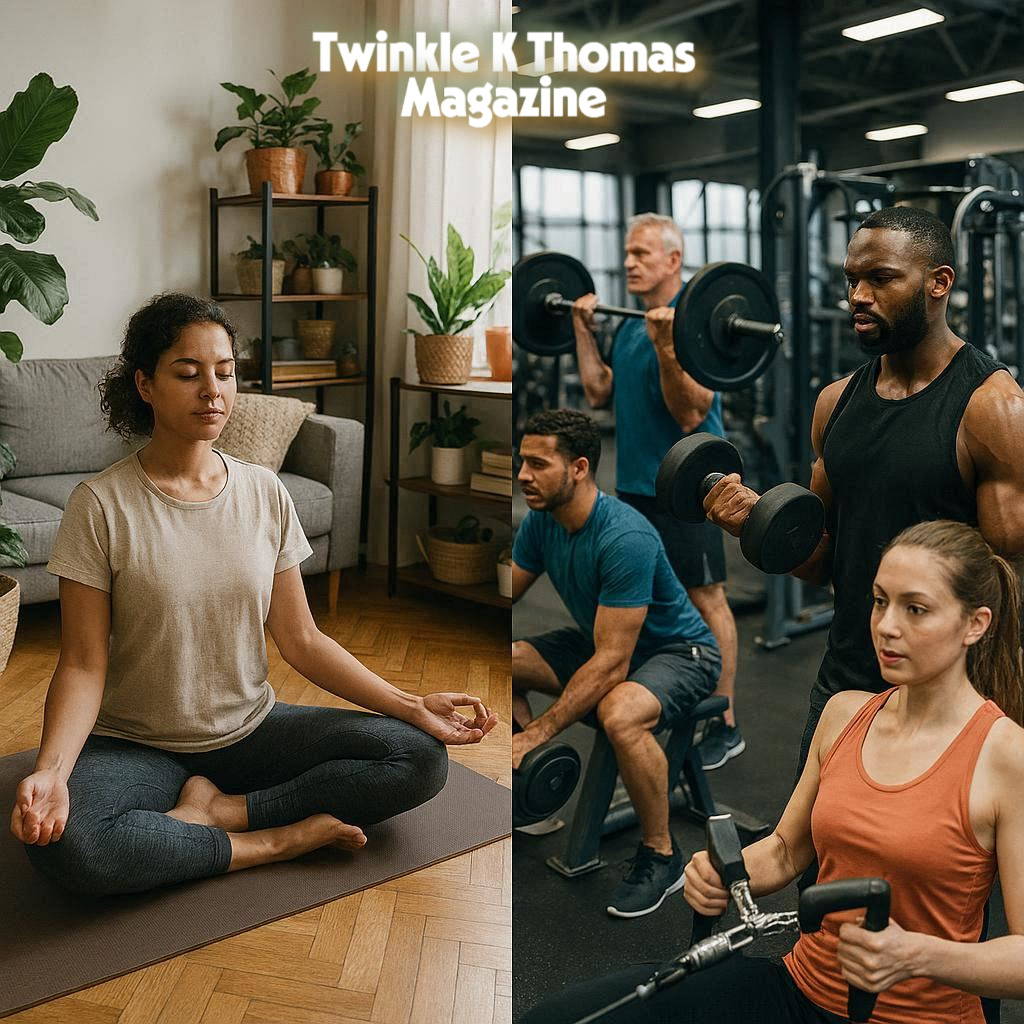
Home workouts or gym memberships? We compare costs, psychology, results & science of home vs. gym exercise to help you build your perfect sustainable fitness routine.
The most effective workout isn’t the one with the most hype; it’s the one you actually do. For millions, the central question in building a fitness routine is location: the convenience of home or the resources of a gym? This isn’t a trivial choice. It’s a decision that impacts your consistency, results, budget, and long-term relationship with fitness.
This comprehensive guide moves beyond personal opinion to analyze the data, psychology, and science behind home exercise and gym exercise. We’ll compare costs, effectiveness, motivational drivers, and potential drawbacks to help you make the perfect, personalized choice for your lifestyle, goals, and personality.
The Core of the Debate: It’s About More Than Equipment
The home vs. gym debate is often framed around equipment, but the real differences are deeper. They revolve around environment, psychology, and lifestyle integration.
- Home Exercise represents autonomy, convenience, and integration of fitness into daily life.
- Gym Exercise represents community, dedicated space, and access to specialized tools for progression.
Let’s break down the comparison across every critical factor.
Head-to-Head Comparison: Home Exercise vs. Gym Exercise
1. Cost & Financial Investment
- Home Exercise:
- Startup Cost: Low to Very High. Can start at $0 (bodyweight). Can escalate with equipment (mat, dumbbells, kettlebells, resistance bands, treadmill, etc.).
- Recurring Cost: $0. Once equipment is purchased, there are no monthly fees.
- Hidden Costs: Space in your home, potential for underused equipment becoming “clothes racks.”
- Gym Exercise:
- Startup Cost: Low. Often just a sign-up fee.
- Recurring Cost: $10 – $200+ per month. Varies wildly from budget chains to premium clubs with pools and classes.
- Hidden Costs: Commute (time & gas), possible annual fees, locker rentals, and the sunk cost of an unused membership (a powerful psychological motivator or source of guilt).
Verdict: Home wins on long-term cost if you’re disciplined. Gym wins on low barrier to entry with no large upfront purchase.
2. Convenience & Time Efficiency
- Home Exercise:
- Pro: The ultimate convenience. No commute, open 24/7, workout in pajamas. Enables “exercise snacking” (short bursts throughout the day).
- Con: Blurred boundaries. Home is also for relaxation, work, and family. It’s easier for fitness to get “squeezed out” by other demands.
- Gym Exercise:
- Pro: Creates a psychological boundary. You go to a dedicated place for a dedicated task. This “destination mindset” can enhance focus.
- Con: Commute time can double your workout commitment. Crowded peak hours can limit equipment access and lengthen sessions.
Verdict: Home wins decisively on pure time savings. Gym wins for those who need a clear physical separation between “life mode” and “fitness mode.”
3. Motivation & Psychology
- Home Exercise:
- Driven by: Intrinsic motivation, self-discipline, and goal setting.
- Risks: Isolation, boredom, and distraction (TV, phone, chores). The lack of a “captive audience” makes it easier to quit mid-workout.
- Best For: Self-starters, introverts, and highly disciplined individuals.
- Gym Exercise:
- Driven by: Extrinsic motivation. This includes the social environment, group energy, seeing others work hard, and even the subtle social pressure of being seen.
- Risks: Intimidation (“gymtimidation”), social anxiety, and comparison to others.
- Best For: Those who thrive on social energy, need external accountability, or enjoy the camaraderie of classes.
Verdict: This is personality-dependent. Extroverts often lean gym, introverts often lean home. Understanding your motivational wiring is key.
4. Equipment, Variety & Progression
- Home Exercise:
- Limitation: Space and budget limit equipment. Progressing past a certain strength point may require creative programming or significant investment.
- Advantage: Forces mastery of foundational, functional movements (squats, push-ups, hinges). Excellent for bodyweight mastery and high-intensity interval training (HIIT).
- Progression Tools: Adjustable dumbbells, resistance bands, suspension trainers (TRX) offer excellent versatility in limited space.
- Gym Exercise:
- Advantage: Access to heavy, fixed-weight equipment (barbells, squat racks, leg press, cable machines). This allows for the most measurable, linear strength progression (adding 5lbs each week).
- Variety: Hundreds of machines and tools to target muscles from every angle, preventing plateaus.
- Specialization: Essential for powerlifters, Olympic lifters, or bodybuilders chasing specific maximal strength or hypertrophy goals.
Verdict: Gym is objectively superior for maximal strength and hypertrophy due to equipment access. Home is superior for foundational fitness, cardio, and general health for the majority of people.
5. Expertise & Guidance
- Home Exercise:
- Challenge: Requires self-education. Form checks are DIY (using phone video).
- Resource: The internet is a double-edged sword—full of great content and dangerous misinformation. Quality apps and paid online coaching can bridge this gap.
- Gym Exercise:
- Opportunity: Access to on-site personal trainers (for an extra fee) for form correction and programming.
- Observation: Can learn by watching experienced members (though this can also lead to copying bad form).
Verdict: Gym has a slight edge if you utilize trainers, but both environments require proactive learning to exercise safely and effectively.
The Science of Results: Can You Get the Same Outcome?
This is the million-dollar question. The science shows that the driver of results is consistent effort and progressive overload, not the location.
- Muscle & Strength (Hypertrophy): A 2017 study in the Journal of Strength and Conditioning Research found that, given equivalent effort and programming, muscle growth is similar whether using machines/free weights or bodyweight/resistance bands. The gym simply makes it easier to add load progressively.
- Fat Loss & Cardiovascular Health: This is 90% driven by nutrition and consistent calorie expenditure. A brutal home HIIT session or a steady-state gym treadmill run can achieve identical metabolic and cardiovascular benefits. Consistency, not equipment, is the key variable.
- Mental Health: Both environments significantly reduce stress and anxiety. The gym may offer a stronger social boost for some, while the home offers privacy and comfort for others.
Conclusion on Results: You can achieve outstanding general fitness, body composition changes, and health markers from either location. The gym offers a more straightforward path to very specific, high-level strength and physique goals.
Who is Each Option Best For? A Decision Matrix
Choose HOME EXERCISE if you:
- Value time efficiency and hate commuting.
- Are self-motivated and disciplined.
- Have social anxiety or prefer privacy.
- Are a beginner establishing a habit.
- Have a tight budget long-term.
- Want to integrate short workouts throughout your day.
Choose GYM EXERCISE if you:
- Need a dedicated space away from home distractions.
- Thrive on group energy or need social accountability.
- Have specific strength or bodybuilding goals requiring heavy weights.
- Enjoy variety and trying new machines/classes (spin, yoga, HIIT).
- Are willing to invest time in the commute for the “experience.”
- Value access to amenities like pools, saunas, or basketball courts.
The Winning Hybrid Strategy
For many, the optimal solution is not an “either/or” but a “both/and” hybrid model.
- Primary at Home, Gym for Top-Up: Do 80% of your workouts at home for consistency. Get a gym day-pass or a budget “class-only” membership once a week for heavy lifting or a favorite class.
- Seasonal Strategy: Gym membership in winter for motivation and warmth; home/outdoor workouts in summer.
- Goal-Based: Use the gym for a 3-month strength-building phase, then maintain at home.
This approach gives you the flexibility to adapt to changing goals, schedules, and motivation levels without feeling locked into one mode.
Conclusion: Your Best Workout is Your Most Consistent Workout
The debate between home exercise and gym exercise isn’t about which is objectively better. It’s about which is subjectively better for you.
- If you will work out more consistently at home, then home exercise is scientifically superior for you, regardless of the gym’s equipment arsenal.
- If the gym environment energizes and commits you, then the membership fee is an investment in your health psychology, not just equipment rental.
Audit your personality, your schedule, your budget, and your goals. Then, choose the environment that removes the most barriers between you and your workout. The perfect fitness routine isn’t found in a specific building; it’s built through the powerful habit of showing up, wherever that may be.
Disclaimer
Please read this disclaimer carefully before beginning any new exercise program.
The information provided in this article is for educational and informational purposes only and is not intended as medical or professional fitness advice.
- Consult a Professional: Always consult with your physician or a qualified personal trainer before starting any new exercise regimen, especially if you have pre-existing health conditions, are new to exercise, or are returning after a long hiatus.
- Prioritize Safety: Proper form is critical to prevent injury in any environment. Whether at home or the gym, start with light weights, focus on technique, and never push through sharp pain.
- Individual Results Vary: Fitness outcomes depend on consistency, nutrition, genetics, and effort. This article compares environments, not guarantees.
- Gym Safety: If choosing a gym, ensure you understand how to use equipment safely and follow all facility rules.