Confused about Vedic vs Western astrology? Learn the 7 major differences between these two systems, including zodiac types, predictive methods, and philosophical foundations.
Vedic vs Western Astrology: Key Differences Explained in Simple Terms
If you’ve ever been puzzled why your Western zodiac sign doesn’t quite resonate while your Vedic sign feels eerily accurate, you’re experiencing firsthand the profound divergence between these two ancient celestial systems. Vedic (Jyotish) and Western astrology represent two distinct philosophical and methodological approaches to interpreting cosmic influences on human life. While both look to the stars for guidance, their paths diverge in fundamental ways that affect everything from your sun sign to life predictions. This comprehensive guide breaks down the seven essential differences that separate these two astrological traditions, helping you understand which system might offer the insights you seek.
The Philosophical Divide: Karma vs Psychology
At their core, Vedic and Western astrology stem from completely different worldviews that shape their entire approach.
Vedic Astrology (Jyotish Shastra) is fundamentally a karmic and spiritual science. Rooted in India’s ancient Vedic scriptures dating back over 5,000 years, it operates on the principle that our birth chart (Janma Kundali) reflects our accumulated karma from past lives (Sanchita Karma) and outlines the specific lessons and experiences (Prarabdha Karma) we’re meant to encounter in this lifetime. The ultimate goal in Jyotish isn’t just prediction but spiritual evolution—helping individuals understand their dharma (life purpose), navigate karmic challenges, and progress toward moksha (liberation). A Vedic astrologer might ask: “What karmic lessons is this person here to learn?” or “How can they align with their soul’s evolutionary path?”
Western Astrology, with roots in Babylonian, Greek, and Egyptian traditions refined during the Hellenistic period, takes a more psychological and personality-focused approach. Emerging prominently in the early 20th century through pioneers like Carl Jung and later popularized in newspapers, it emphasizes self-discovery, personal potential, and understanding one’s character. Western astrology asks: “What are this person’s inherent traits?” and “How can they maximize their potential for happiness and success in this lifetime?”
This philosophical chasm creates vastly different interpretations. Where Vedic astrology might see a challenging Saturn placement as a karmic debt requiring repayment through discipline, Western astrology might interpret the same placement as an area where one needs to develop maturity and structure.
The Great Zodiac Split: Sidereal vs Tropical
This is the most talked-about and calculable difference between the two systems, and it’s why your sun signs likely don’t match.
Vedic Astrology uses the Sidereal Zodiac, which is based on the fixed, observable constellations as they exist in the sky today. It acknowledges and accounts for a phenomenon called the precession of the equinoxes—the gradual wobble of Earth’s axis that causes the zodiac to slowly shift relative to the seasons. Over 2,000 years, this wobble has created approximately a 23-degree gap between the constellations and where they were when Western astrology was standardized. Vedic astrology corrects for this shift using what’s called an Ayanamsa (most commonly the Lahiri Ayanamsa), effectively recalibrating the zodiac to match current astronomical reality.
Western Astrology uses the Tropical Zodiac, which is based on the relationship between the Sun and Earth’s seasons, not the constellations. It fixes 0° Aries at the vernal equinox (around March 21) each year, maintaining a seasonal cycle that stays consistent year after year but has drifted away from the actual constellations that originally gave the signs their names.
The Practical Effect: Because of this 23-degree shift, if you’re born between March 12 and April 12, for example, you’re likely an Aries in Western astrology but a Pisces in Vedic astrology. This single difference explains why many people feel more connection to their Vedic sign—it’s astronomically accurate to the current sky.
Chart Systems and House Division Methods
How the celestial wheel is divided into houses reveals another layer of divergence.
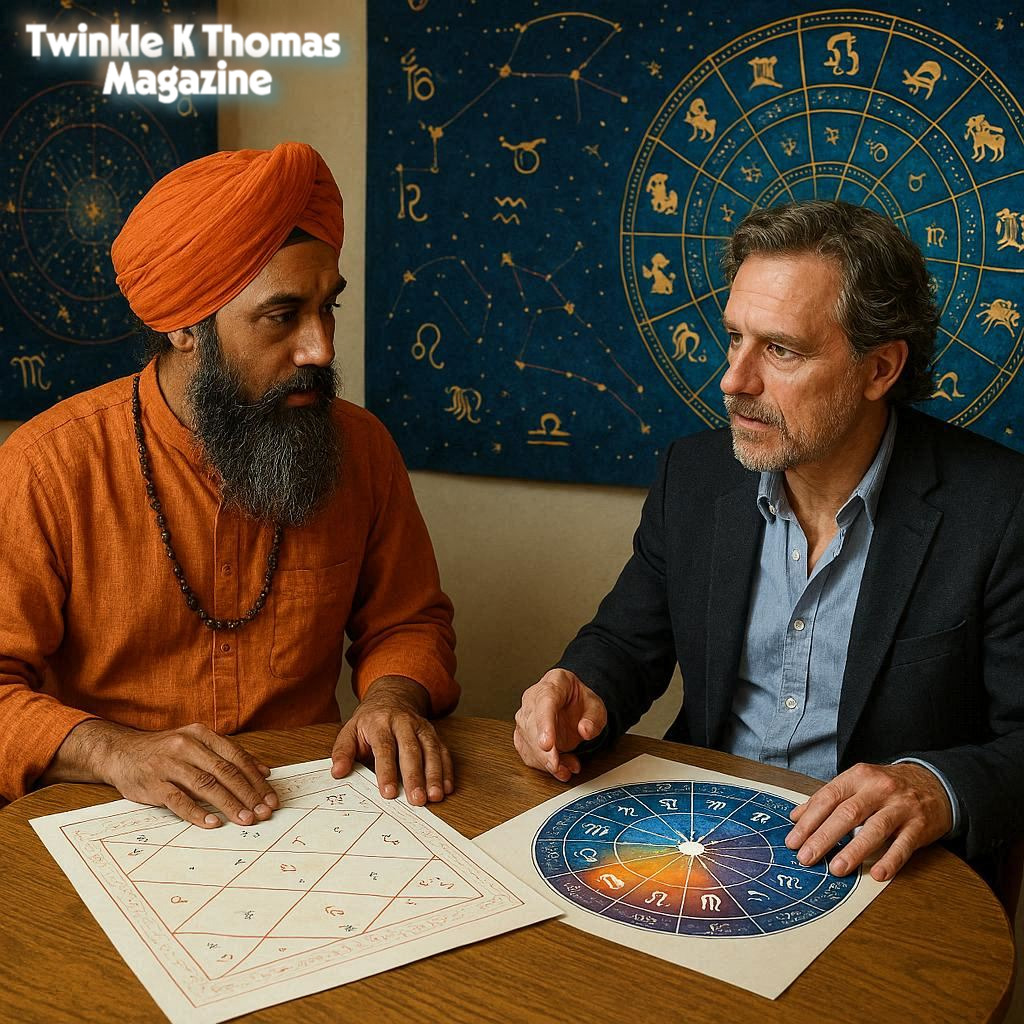
Vedic Astrology predominantly uses the Whole Sign House system, considered the oldest and simplest method. In this system, whatever sign is on the ascendant (rising sign) occupies the entire first house. The next sign occupies the entire second house, and so on. This creates clear, unambiguous house-sign relationships and is considered more aligned with Vedic astrology’s philosophical roots. The chart style is typically a square or diamond-shaped format called the North Indian Chart (showing houses fixed) or South Indian Chart (showing signs fixed).
Western Astrology employs several house division systems, with Placidus being the most common in modern practice. Other systems include Koch, Equal House, and Regiomontanus. These systems create unequal house sizes based on latitude and time calculations, resulting in intercepted signs (where a sign may be entirely contained within a house) and duplicated signs (where one sign may span two houses). The circular chart format is standard, with houses radiating from the center like pie slices.
This difference affects interpretations significantly. In Vedic astrology’s Whole Sign system, a planet at 29° of a sign is in the same house as a planet at 1° of the same sign. In Western’s Placidus system, these same two planets could potentially be in different houses if the house cusp falls between those degrees.
Planetary Lineup: Different Players, Different Roles
The cast of celestial characters differs between systems, particularly regarding modern planets.
Vedic Astrology recognizes nine primary celestial bodies called Navagrahas:
- Sun (Surya), Moon (Chandra), Mars (Mangal), Mercury (Budha), Jupiter (Guru), Venus (Shukra), Saturn (Shani)
- Plus the two lunar nodes: Rahu (North Node) and Ketu (South Node)
Notably, Vedic astrology does not traditionally include Uranus, Neptune, or Pluto as primary planets, though some modern practitioners may reference them. Rahu and Ketu (the nodes where the Moon’s path crosses the Sun’s path) are considered especially important as “shadow planets” or “karmic points” that indicate past-life patterns and soul evolution.
Western Astrology utilizes ten primary celestial bodies:
- The seven classical planets: Sun, Moon, Mercury, Venus, Mars, Jupiter, Saturn
- Plus the three modern planets: Uranus (discovered 1781), Neptune (1846), and Pluto (1930, now classified as a dwarf planet but still used)
The lunar nodes are sometimes considered but generally play a less central role than in Vedic astrology. Each modern planet is assigned specific generational and psychological meanings—Uranus as the awakener, Neptune as the mystic, Pluto as the transformer.
Predictive Techniques: Dashas vs Transits
How each system forecasts timing and events reveals their different approaches to destiny.
Vedic Astrology’s predictive power centers on the Dasha system, specifically the Vimshottari Dasha—a 120-year cycle of planetary periods. Your birth determines which planetary period (Mahadasha) you’re born into, and each planet rules for a specific number of years (e.g., Venus for 20 years, Saturn for 19 years). These are further divided into sub-periods (Antardasha) and sub-sub-periods (Pratyantardasha). This system provides remarkably precise timing for when different areas of life will be activated. Additionally, Vedic astrology uses transits (Gochara) and ashtakavarga (a point system for planetary strength) for predictions.
Western Astrology relies heavily on Transits (where planets are currently moving), Progressions (especially Secondary Progressions, where each day after birth symbolizes a year of life), and Solar Returns (a chart for the moment the Sun returns to its exact natal position each birthday). While Western astrology has timing techniques like profections, they generally don’t offer the same detailed long-term timeline as the Vimshottari Dasha system.
Remedial Measures vs Psychological Integration
What do you do with challenging astrological indications? The two systems offer different solutions.
Vedic Astrology provides specific Remedial Measures (Upayas) based on the principle that planetary energies can be harmonized. These include:
- Mantras: Chanting specific Sanskrit sound vibrations for each planet
- Gemstones (Ratnas): Wearing gems corresponding to weak or afflicted planets
- Yantras: Meditating on geometric diagrams representing planetary energies
- Charity (Dana): Giving specific items on specific days to appease planets
- Rituals (Pujas/Homas): Fire ceremonies performed by priests
- Color therapy, dietary changes, and lifestyle adjustments
Western Astrology typically focuses on Psychological Integration and Conscious Choice. A Western astrologer might help you understand that your challenging Saturn placement calls for developing discipline in a particular area, or that your Uranus square suggests embracing your uniqueness despite societal pressure. The emphasis is on self-awareness, therapy, and conscious behavioral changes rather than external remedies.
Relationship Analysis: Compatibility vs Synastry
Both systems analyze relationships but with different tools and intentions.
Vedic Astrology uses Kundali Matching (Guna Milan) for marriage compatibility, particularly in arranged marriage traditions. This involves comparing 36 points across eight categories (Ashtakoota), including emotional compatibility (3 points), health (8 points), destiny (5 points), and more. A score above 18 is generally considered acceptable, with higher scores indicating better compatibility. The system also examines the 7th house of marriage, its lord, and Venus for both partners.
Western Astrology employs Synastry and Composite Charts. Synastry compares two birth charts to see how planets interact between them (your Moon conjunct their Venus, etc.). Composite charts create a new “relationship chart” from the midpoint between both partners’ planetary positions. The focus is less on predetermined compatibility scores and more on understanding the dynamics, strengths, and challenges of the relationship.
Accuracy and Purpose: Different Goals, Different Approaches
It’s crucial to understand that both systems can be “accurate” within their own frameworks—they’re simply measuring different things with different tools.
Vedic Astrology aims for Specific Event Prediction and Karmic Understanding. Practitioners often make precise predictions about career changes, marriage timing, health issues, and financial gains/losses. The system’s strength lies in its timing techniques (Dashas) and its detailed analysis of planetary strengths and weaknesses.
Western Astrology excels at Character Analysis and Psychological Insight. It’s particularly effective at describing personality traits, relationship dynamics, and psychological patterns. Its strength lies in helping individuals understand themselves and make conscious choices.
Many modern astrologers are beginning to synthesize both systems, using Vedic techniques for timing and karmic insight while employing Western methods for psychological depth. This integrative approach recognizes that both systems offer valuable perspectives.
Which System Should You Choose?
Consider Vedic Astrology if you want to:
- Understand your karmic patterns and life purpose
- Get specific timing for life events
- Explore past-life influences
- Use practical remedies for challenging periods
- Make decisions about marriage, career, or relocation with traditional methods
Consider Western Astrology if you want to:
- Deepen self-understanding and psychological insight
- Explore personality dynamics and relationship patterns
- Work with a system that integrates modern planetary discoveries
- Focus on personal growth and conscious choice
- Access widely available resources and familiar sun-sign information
Conclusion: Two Maps of the Same Territory
Imagine Vedic and Western astrology as two different maps of the same city. One might be a detailed street map showing every alley and building (Vedic), while the other is a subway map showing connections between major stations (Western). Both are valid representations; they simply emphasize different aspects and serve different purposes.
The fundamental differences between Vedic and Western astrology stem from their distinct cultural origins, philosophical foundations, and historical developments. Vedic astrology offers a vertical, karmic depth—looking at your soul’s journey across lifetimes. Western astrology provides a horizontal, psychological breadth—exploring your personality and potential in this lifetime.
Rather than asking which system is “right,” the more enriching question might be: “What can I learn from each?” Many find that Vedic astrology explains the “what” and “when” of their life patterns, while Western astrology illuminates the “why” and “how” of their personal experience. Together, they offer a more complete cosmic perspective—one that honors both your karmic journey and your psychological becoming in this singular, precious human life.